
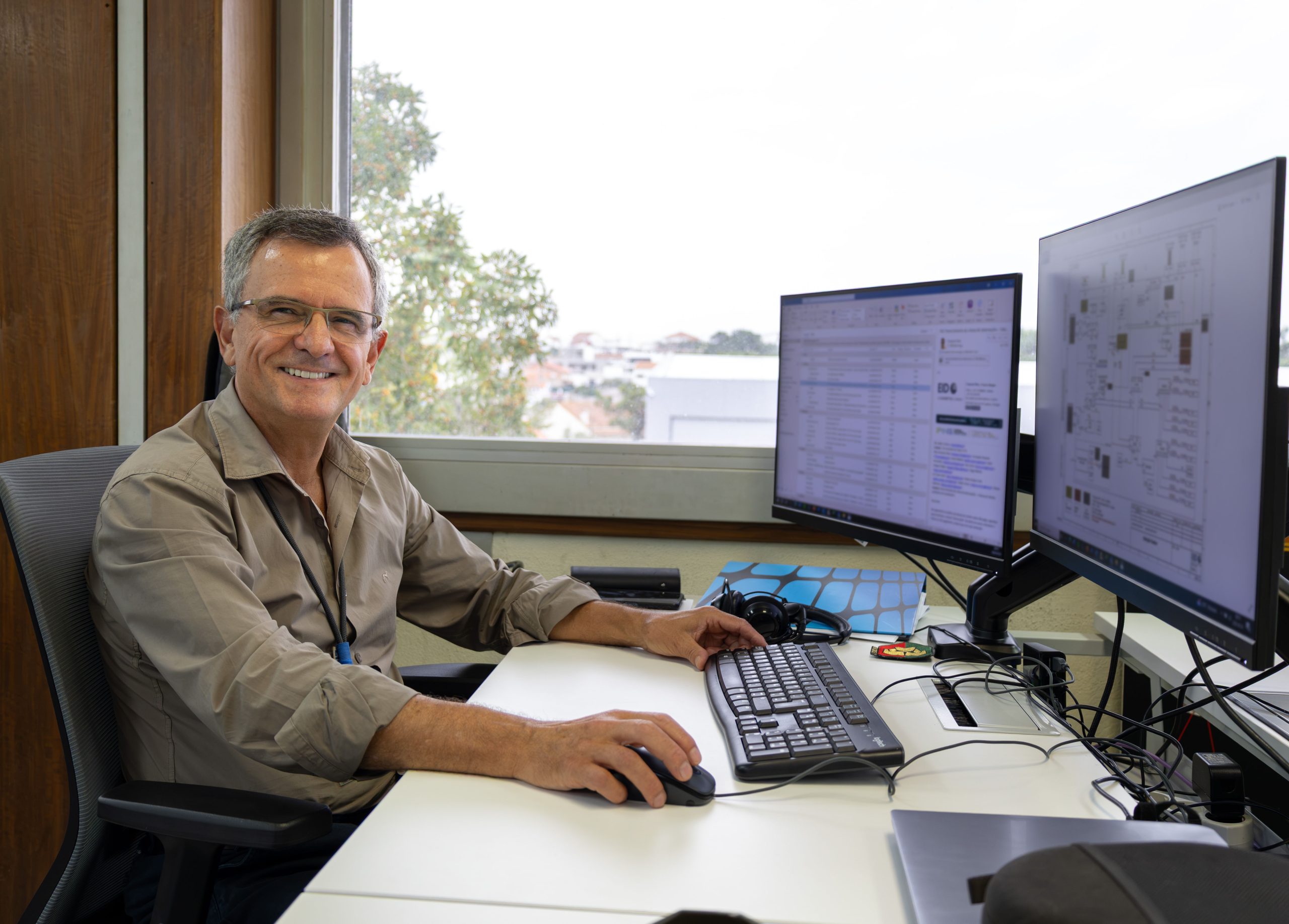
From his first days at SISTEL to managing major defence programmes, Delfim Veiga has spent four decades growing alongside EID and helping its solutions reach the field.
In 2026, Delfim Veiga celebrates 40 years connected to EID. Four decades marked by technological change, major programmes, evolving responsibilities and countless experiences with colleagues and customers.
His journey, however, did not begin inside EID… It started in 1986, at SISTEL, a company located next door to EID and working closely with it at the time. What followed was a career that would take Delfim from technical development and civil applications to tactical communications, programme management and direct involvement in some of EID’s most significant defence programmes, but beyond projects and technologies, his story is also one of people: colleagues who became friends, football matches, walks, teamwork, challenges and a strong sense of responsibility towards the customer.
From SISTEL to EID: the beginning of the journey
When Delfim looks back at his early years, one of his first memories is not necessarily about a particular project but about the people around him.
At SISTEL, he joined a development team working on SCADA systems for dam control. At the time, EID and SISTEL maintained a close working relationship, with EID developing prototypes and SISTEL taking responsibility for commercialisation – the environment was very different from today’s EID.
One of Delfim’s memories from those early days is a room with around 20 people, no windows and, as he recalls with a laugh, “so much cigarette smoke that I couldn’t see my colleague on the other side of the room.”
There was also a strong sense of camaraderie: football matches between EID and SISTEL, walks around the cliffs of Sesimbra and other activities brought colleagues together outside their day-to-day work. That sense of connection would remain an important part of Delfim’s experience throughout his career.
From civil technology to defence programmes
Following the acquisition of SISTEL, Delfim’s team eventually moved to EID, where he continued working in the civil technology area before increasingly becoming involved in the company’s defence activities. One of the projects he recalls from this period was the environmental monitoring programme around the Pego Power Plant, in Abrantes. EID was responsible for monitoring particles and assessing the plant’s environmental impact on surrounding communities, with Delfim taking responsibility for the project.
His career then moved increasingly towards tactical communications. He participated in a NATO interoperability study, contributing to work around tactical communications standards, before taking a new step in his career in the mid-2000s.
Programme and contract management would become the next major chapter of his journey.
The PANDUR programme: a new challenge
Around 2006/07, Delfim moved into programme and contract management.
One of the first major challenges he took on was EID’s involvement in the PANDUR programme, supplying the ICC-201 intercom system and radio systems for the Portuguese Armed Forces. It was a demanding responsibility and one that came with a particularly memorable first experience. At one point, Delfim had to attend customer acceptance tests for the programme. With much of the team focused on another major contract, he found himself taking on the challenge largely on his own. It was his first time in that role, facing several customer representatives and technical teams.
“I was nervous because it was the first time I was going to be there in front of several people from the customer and technical teams, but I managed to get through it.”
That experience became part of a much larger programme that would run for several years, covering supply, installation, commissioning and customer support. For Delfim, it was also an important step in developing the experience that would define much of his career.
From tactical radios to long-term customer relationships
In 2013, Delfim took over responsibility for the GRC-525 programme, involving the supply of tactical radios and associated equipment to the Portuguese Army and Marines. The programme continued for several years and was followed by further contracts, including a subsequent GRC-525 programme launched in 2019.
Alongside these programmes for the Portuguese Armed Forces, Delfim also managed tactical communications projects for international customers, with EID systems reaching countries including Singapore, Malaysia and Indonesia, in some cases through partnerships with Rohde & Schwarz.
More recently, he has also been involved in the Soldier System programme, supplying equipment for lower-echelon forces.
Many of these programmes span several years and for Delfim, that long-term perspective has meant building trust with customers, understanding their operational needs and ensuring that the solutions delivered meet the demands of the people who ultimately depend on them.
When technology reaches the field
Even after four decades, Delfim continues to be involved in field activities, supporting implementation and training around EID systems and for him, this remains one of the most rewarding aspects of the work.
“I feel very proud of what we do. I always try to do my best and look for the solutions that best suit the operational environments.”
That commitment extends beyond the equipment itself. Feedback from customers, he explains, is an essential part of improving systems and ensuring that future deliveries are better.
His approach has always been guided by a strong sense of responsibility towards the customer and by the understanding that EID’s systems can ultimately be used in demanding operational environments.
“I have a lot of respect for the customer. I have always approached the mission with the mindset of delivering the best possible systems, on time.”
40 years of change and the importance of remembering
Over four decades, Delfim has witnessed enormous changes in technology, processes, products and in EID itself but when asked about the changes that matter most today, his answer is not only about technology.
For him, one of the most important challenges for the company’s future is ensuring that knowledge and experience are not lost as EID continues to evolve. As new generations join the company, preserving the history of products, customers and programmes becomes increasingly important.
“It is important to know the history and understand what happened, so that we don’t disappoint customers with certain attitudes. There is also a history with each customer, and they expect certain behaviours from the company.”
The people behind the programmes
For all the projects, systems and programmes that make up his career, Delfim’s memories ultimately come back to people: the colleagues he worked alongside, the teams that helped deliver difficult programmes, the friendships built over the years and the sense of camaraderie that accompanied much of his journey. It is also why, when asked what he will take with him from these 40 years, he doesn’t point to one specific programme. Instead, he speaks about a good working environment, his colleagues and the knowledge that the systems he helped deliver are being used by customers – that is what makes the idea of a “mission accomplished” particularly meaningful.
A mission accomplished
After four decades, Delfim describes his journey simply:
“For me, it has been a mission, a mission accomplished.”
From a young professional starting out at SISTEL to a programme manager responsible for long-term defence contracts, Delfim has witnessed EID evolve from a very different company into the organisation it is today and perhaps that is the most meaningful way to look back on 40 years: not simply as four decades spent at a company, but as four decades of growing with it, contributing to its journey and helping build the solutions that make a difference.